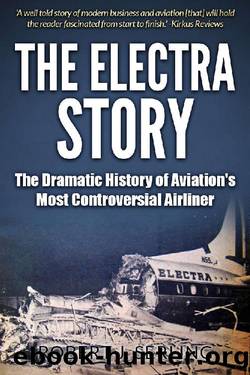
The Electra Story: The Dramatic History of Aviation's Most Controversial Airliner by Robert J Serling
Author:Robert J Serling [Serling, Robert J]
Language: eng
Format: epub
Publisher: Endeavour Media
Published: 2017-06-22T07:00:00+00:00
“This undertaking,” an official Lockheed background statement to the nation’s press declared, “spreads across the entire panorama of aviation science. Investigators cannot afford to overlook any avenue. As they proceed down each, the search will become narrower. It is narrowing already.”
It was.
There are more than one hundred different kinds of flutter. Modes, they are called. One hundred individual ways in which metal can vibrate. The searchers began checking out each one. And they had, by now, a pretty good idea which mode they were looking for.
The damage marks on Braniff’s number one propeller displayed signs of its having wobbled. There was the sound witnesses had heard that clear September night. When the tape recording of an overspeeding prop had been played, several remarked, “That’s it.” An overspeeding prop on an Electra was known to present no particular menace or danger. But suppose the overspeeding was merely a symptom of something else that was wrong in the power plant?
In Indianapolis, in Burbank, in NASA’s Langley wind tunnels, the investigators tried every form of flutter mode in the book and tried to link it to the over speeding prop.
They found one. During this single mode, the propeller tips approached sonic velocity without any increase in revolutions per minute or air speed. On May 5, 1960, while more than one hundred and fifty Electras the world over plodded shamefacedly at the speeds of DC-6s and Constellations, a Lockheed engineer stood up at a meeting of CAB and FAA officials and spoke six fatal words:
“We’re pretty sure it’s whirl mode.”
Whirl mode was nothing new. It was not a mysterious phenomenon. It was far from an unknown force. As a matter of fact, it is a form of vibrating motion inherent in any piece of rotating machinery such as oil drills, table fans, and automobile drive shafts.
As far back as the early 1930s, the application of whirl mode to the airplane propeller was a subject discussed in technical journals. Two physicists published a lengthy paper about it in 1938. Dr. Robert Scanlon, professor of aero-elasticity at the Case Institute of Technology, studied and wrote about whirl mode as recently as 1950. Scanlon and other scientists also referred to it as propeller auto-precession, propeller-nacelle whirl flutter, and gyro-flutter.
The theory was devastatingly simple and, purely hypothetically up to now, also devastating. A propeller has gyroscopic tendencies. In other words, it will stay in a smooth plane of rotation unless it is displaced by some strong external force, just as a spinning top can be made to wobble if a finger is placed firmly against it. The moment such a force is applied to a propeller, it reacts in the opposite direction.
Suppose the force drives the propeller upward. The stiffness that is part of its structure promptly resists the force and pitches the prop forward. Each succeeding upward force is met by a protesting downward motion. The battle of vibration progresses. The propeller continues to rotate in one direction, but the rapidly developing whirl mode is vibrating in the opposite direction.
Download
This site does not store any files on its server. We only index and link to content provided by other sites. Please contact the content providers to delete copyright contents if any and email us, we'll remove relevant links or contents immediately.
| Automotive | Engineering |
| Transportation |
Flying Boats by Charles Woodley(691)
Aircraft Basic Science, Eighth Edition by Michael Kroes(596)
A Week at the Airport (Vintage International) by Alain De Botton(564)
Braniff Airways: Flying Colors (Images of Modern America) by Richard Benjamin Cass(502)
Pan American World Airways by Laura J. Hoffman(493)
A Week at the Airport by Alain De Botton(477)
DHL by Po Chung(463)
Flying the Big Jets () by Stanley Stewart(460)
Skyjack by Geoffrey Gray(420)
Nerves of Steel by Captain Tammie Jo Shults(411)
The Mystery of Flight 427 by Bill Adair(399)
Michael O'Leary by Alan Ruddock(396)
Skyjack: The Hunt for D. B. Cooper by Geoffrey Gray(368)
SKYJACK: The Hunt for D. B. Cooper by Geoffrey Gray(348)
Scapegoat by Emilio Corsetti III(346)
Men Who Killed Qantas by Matthew Benns(338)
Risk Management and Corporate Sustainability in Aviation by Flouris Triant G. Kucuk Yilmaz Ayse. & Ayse Kucuk Yilmaz(330)
Flying The Big Jets (4th Edition) by Stewart Stanley(313)
Flight Attendant Memoir by Anderson Margo(290)
